

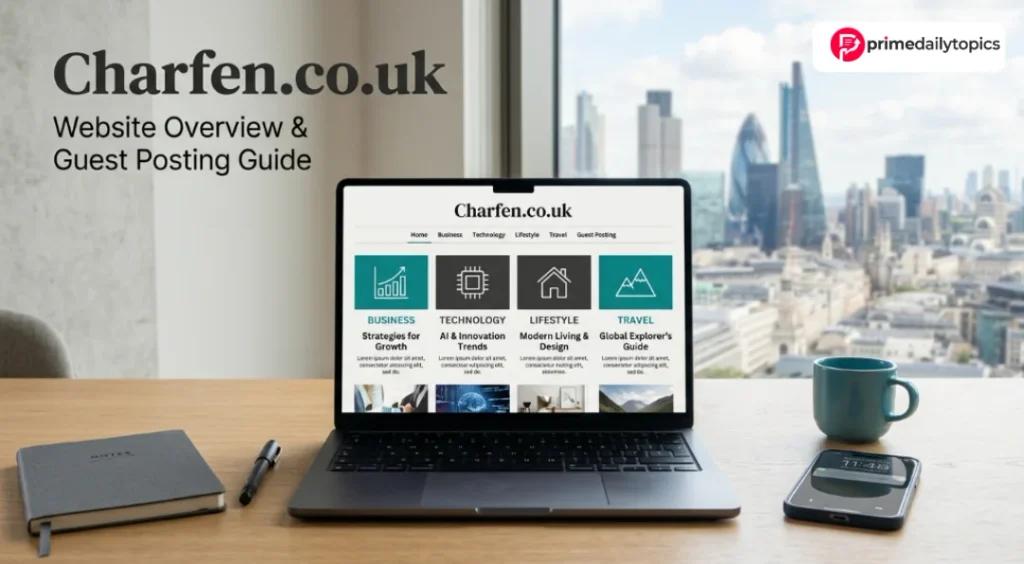
Charfen.co.uk is a multi-topic publishing website featuring business, technology, lifestyle, food, health, travel, and home improvement content. Although its About page emphasizes entrepreneurship and business growth, its visible publishing activity covers a much wider range of subjects.
For readers, the site offers articles to browse across different interests. For writers, it publishes guest contribution guidelines. Understanding those two functions provides a clearer picture than relying on its business-focused descriptions alone.
What Is Charfen.co.uk?
The website’s About page presents a mission of helping entrepreneurs access practical knowledge and strategies from successful business leaders. It describes expert insights, actionable advice, and community support as parts of its approach.
Those are the publisher’s stated aims. The page does not identify the specific experts or provide supporting case studies for its broad claims about tested strategies and business results. Readers should distinguish the website’s positioning from evidence of professional expertise.
Its footer describes a publication covering UK-related information, lifestyle, culture, and current affairs. Together, these descriptions suggest overlapping editorial identities rather than one clearly defined specialist focus.
What Topics Does the Website Cover?
The main navigation includes business, food, health, home improvement, lifestyle, news, and technology. The homepage also highlights travel and other categories.
Visible article subjects range from buying a first car and preparing a home for a holiday to industrial equipment and marketing psychology. This variety makes the site a general-interest publication with some business content. Its articles also extend beyond UK subjects.
Readers seeking an introduction to a topic may find relevant material through the category menus. The breadth of coverage, however, makes it useful to assess each article separately: a helpful lifestyle post does not establish the authority of an unrelated technical explanation.
How Consistent Is the Website’s Presentation?
Several public pages contain details that do not align neatly with the business and general-interest branding.
The contact page includes a cooking-blog introduction under the name Alex Thompson. It also links a mailing-list invitation to a theme demonstration website, while the retrieved page text displays a contact-form shortcode. These elements suggest that parts of the page may retain template content or need maintenance. They do not establish who owns or manages the publication.
The contributor page also retains an introductory placeholder asking the publisher to insert its blog topics. This is a concrete editorial issue, although it does not by itself determine the accuracy of every published article. Source: Write for Us
These inconsistencies matter because About and Contact pages should help visitors identify a publication and understand how to reach its team. When those pages provide mixed signals, direct clarification becomes more useful.
Does Charfen.co.uk Accept Guest Posts?
Yes. Its Write for Us page explicitly welcomes guest contributions across business, technology, lifestyle, health, travel, food, entertainment, and related subjects.
The published instructions request original, previously unpublished work, clear formatting, a short author biography, and credited images where appropriate. Submissions can be provided in Word or Google Docs format.
The length requirement uses the ambiguous wording “at least 800–1,500 words.” Contributors should clarify the preferred length before drafting. The reviewed guidelines also leave practical questions about fees, link policies, and publication terms unanswered.
A useful inquiry would identify the proposed topic, intended audience, and original contribution, then ask for the current terms. That gives both writer and publisher enough information to decide whether the article fits.
How to Evaluate an Article Before Using It
Start with the article’s author, date, and supporting references. A byline helps identify responsibility, while references allow readers to check whether a claim is supported.
For example, an article discussing a software feature should ideally point to the developer’s documentation. A claim about a study should identify the research. A detailed number without an identifiable source deserves further checking before it is repeated.
Also consider whether the article answers its title’s question with concrete information. Examples, clear explanations, and relevant evidence provide more value than broad promises about success or improvement.
For contributors, apply the same attention to the publication agreement. Confirm whether edits require approval, whether a biography will appear, and whether the article can later be updated or removed. These details define the publishing arrangement more clearly than an invitation to submit.
Frequently Asked Questions
Is Charfen.co.uk only a business website?
No. Its About page emphasizes entrepreneurship, but its public article categories cover a broad range of subjects.
Who owns Charfen.co.uk?
The reviewed About and Contact pages did not clearly establish the legal owner. The cooking-related introduction on the contact page is insufficient evidence to identify the publisher.
Is Charfen.co.uk connected to another Charfen-branded business?
An affiliation was not established from the pages reviewed. A shared name should not be treated as proof of a partnership or common ownership.
Is guest posting free?
The reviewed submission guidelines do not specify a fee. Ask the published contact for current terms before assuming that publication is free or paid.
Who is the website most relevant to?
Its visible format suits readers browsing general-interest articles and writers investigating contribution opportunities. Anyone seeking a specific professional service should first obtain a clear description of that service and the people responsible for delivering it.
Discover more at The Fame Mint