
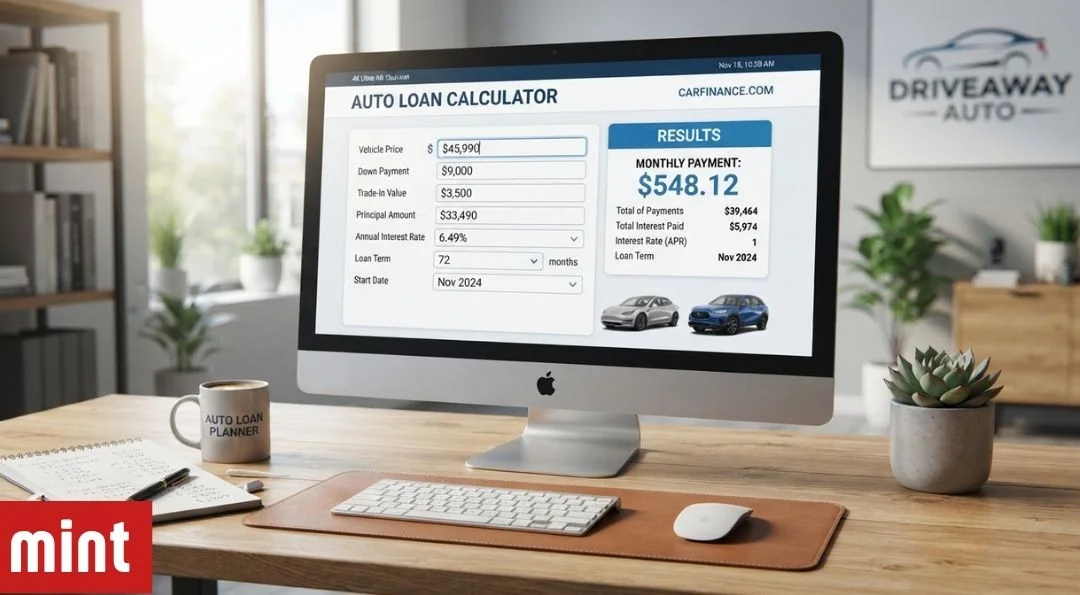
A car payment calculator estimates how much you may pay each month for an auto loan. Enter the vehicle price, down payment, trade-in value, annual percentage rate (APR) and loan term to compare financing options before you visit a dealership.
However, the monthly payment tells only part of the story. A longer loan term can reduce your monthly bill while increasing your total interest. Therefore, compare the payment, total interest and overall cost before choosing a loan.
How to calculate a car payment
Start by estimating the amount you need to finance:
Loan amount = vehicle price + taxes and fees + add-ons − down payment − net trade-in value
Next, apply the interest rate and loan term. Most car payment calculators use the standard amortized-loan formula:
Monthly payment = P × [r(1 + r)ⁿ] ÷ [(1 + r)ⁿ − 1]
In this formula:
- P represents the principal, or amount financed.
- r represents the monthly interest rate.
- n represents the total number of monthly payments.
To find the monthly interest rate, divide the annual rate by 12. For example, a 6% annual rate becomes 0.005 per month when expressed as a decimal.
Fortunately, you do not need to calculate this formula manually. A car payment calculator can handle the math and help you test several prices, rates and terms quickly.
Information you need for an accurate estimate
A calculator produces useful results only when you enter realistic figures. Therefore, gather the following information before comparing loans.
Vehicle price
Use the negotiated price rather than the manufacturer’s suggested retail price. Better yet, request the vehicle’s out-the-door price, which generally includes taxes and dealer fees.
Down payment
A larger down payment reduces the amount you need to borrow. As a result, it can lower both your monthly payment and total interest.
However, avoid using all your available savings. You may still need money for registration, insurance, maintenance or an unexpected repair.
Trade-in value
Enter the dealer’s trade-in offer for your current vehicle. If you still owe money on that vehicle, subtract the remaining loan balance from the trade-in value.
For example, suppose a dealer offers $12,000 for your car, but you still owe $9,000. In that case, your net trade-in value equals $3,000.
Conversely, if you owe more than the vehicle’s value, you have negative equity. Rolling that balance into a new loan increases the amount financed and may leave you owing more than the replacement vehicle is worth.
Interest rate or APR
Your credit history, income, loan amount, lender and vehicle can all affect your rate. Although people often use “interest rate” and “APR” interchangeably, they may represent different costs. The APR can reflect certain financing charges in addition to interest.
For a realistic calculation, use the APR from a lender’s preapproval or written offer. Otherwise, the result provides only a rough estimate.
Loan term
The loan term tells you how many months you will take to repay the debt. Common terms include 36, 48, 60, 72 and 84 months.
A longer term usually lowers the monthly payment. Nevertheless, it often increases total interest and extends the period during which you could owe more than the car’s market value. The Consumer Financial Protection Bureau’s auto-loan guidance explains that shorter terms generally reduce total loan costs.

Taxes and fees
Sales tax, registration charges, documentation fees and optional products can significantly change the final payment. Because these costs vary by location and transaction, review a written price breakdown before signing.
Car payment calculation example
Suppose you plan to purchase a car with the following terms:
| Cost or loan detail | Amount |
|---|---|
| Vehicle price | $32,000 |
| Taxes and fees | $2,500 |
| Down payment | $4,500 |
| Amount financed | $30,000 |
| Interest rate | 6.5% |
| Loan term | 60 months |
With these figures, the estimated monthly payment equals approximately $587. Over 60 months, you would pay about $35,219, including roughly $5,219 in interest.
This estimate excludes insurance, fuel, maintenance and repairs. Consequently, your actual monthly cost of owning the car will exceed the loan payment.
How different loan terms affect the payment
The following example uses a $30,000 loan at a fixed 6.5% annual interest rate. Actual offers may use different rates for different terms.
| Loan term | Estimated monthly payment | Estimated total interest |
|---|---|---|
| 36 months | $919 | $3,096 |
| 48 months | $711 | $4,152 |
| 60 months | $587 | $5,219 |
| 72 months | $504 | $6,306 |
| 84 months | $446 | $7,434 |
Extending the term from 36 to 84 months reduces the estimated payment by about $473. However, it more than doubles the estimated interest cost.
Therefore, choose the shortest term that supports a manageable payment and leaves room for your other financial priorities.
How to lower your monthly car payment
Several changes can reduce an estimated payment:
- Negotiate a lower vehicle price. A lower price reduces the principal immediately.
- Increase your down payment. Borrowing less usually lowers both the payment and interest cost.
- Choose a less expensive model. This approach can also reduce insurance and registration expenses.
- Improve your credit before applying. A stronger credit profile may help you qualify for a better rate.
- Compare several lenders. Banks, credit unions and dealer-arranged lenders may offer different terms.
- Remove unnecessary add-ons. Service contracts and other optional products can increase the amount financed.
- Select a longer term cautiously. Although it lowers the payment, it usually raises the total cost.
Most importantly, negotiate the vehicle price separately from the financing. If you discuss only a target monthly payment, a seller can extend the loan term to make an expensive vehicle appear affordable.
Compare total cost, not only the payment
The Federal Trade Commission’s car-financing guidance recommends comparing the negotiated price, APR, loan term and amount financed—not just the monthly payment.
Additionally, include the broader costs of ownership in your budget:
- Auto insurance
- Fuel or charging
- Routine maintenance
- Repairs
- Registration and inspections
- Parking and tolls
- Depreciation
The CFPB likewise advises consumers to consider insurance, maintenance and operating expenses when deciding how much they can afford to borrow.
Frequently asked questions
How much would a $30,000 car loan cost per month?
A $30,000 loan at 6.5% for 60 months would cost approximately $587 per month. However, a different APR or term will change the result.
Does a car payment calculator include taxes?
Only if you enter them. Some calculators estimate taxes from your location, while others require you to add sales tax and fees to the vehicle price manually.
Does checking an estimated payment affect my credit score?
Using a calculator does not affect your credit. However, a lender may review your credit when you request preapproval or submit a formal application.
Why does the dealer’s payment differ from the calculator?
The dealer may use a different APR, term, tax amount or down payment. In addition, the contract may include warranties, insurance products, negative equity or other add-ons. Ask for an itemized breakdown to identify the difference.
Is a 72-month car loan a good choice?
A 72-month loan may provide a more manageable payment, but it usually costs more in interest and increases the risk of negative equity. Compare it with shorter terms before deciding.
Read More The Fame Mint